“Imitation is about copying; emulation is when imitation goes one step further, breaking through into your own thing” – Austin Cleon.
I am trying to build a biologically plausible AI. There are two aspects to this:s one is Project Elihu, which is looking intently at simulating and matching brain waves, and another project where working on applying that as an LLM.
The LLM part
The LLM part is going through the evolutionary algorithm. Seems to be fine; inputs seem feasible. The OMEN idea looks feasible. Though it did seem to rely more on slightly different chemical proportions than the initial tests. This was interesting for me, and I had to look up if different human neuron types have different amounts of ion gates depending on their task, and that does seem the case,e so that was interesting that I learned that from the simulation and biology confirmed it, and that's the first case it's worked that way and not the other way round.
How Good Is The Emulation
There are a few attempts to either predict the next state of the brain, some using transformers, others have used dedicated low-granularity simulations such as the Blue Brain Project. I have been trying to build a purpose-built design. Now this one uses 30 sensors, and a single neuron in the human brain probably can move an EEG by about 1 millivolt when it fires (could be more or less depending on proximity to the electrode). The EEG itself has about a 10 millivolt error range from noise from electricity from other parts of the brain creating interference, and just the fact that a thick bone skull just sort of insulates stuff a bit.
So I am thinking if under 30 (30 sensors), that is like being highly in line with both. Under 300, it's in the window for saying it's in the range of error,r and 300 or over, you're probably not syncing. I have kept returning to this, trying to figure out accuracy and if the AI network is learning about the human brain waves as it learns and becoming more accurate (which would be great).
Graphing my best performer, looking at the error and showing the distance between the AI brain wave and the human brain wave, trying to emulate with
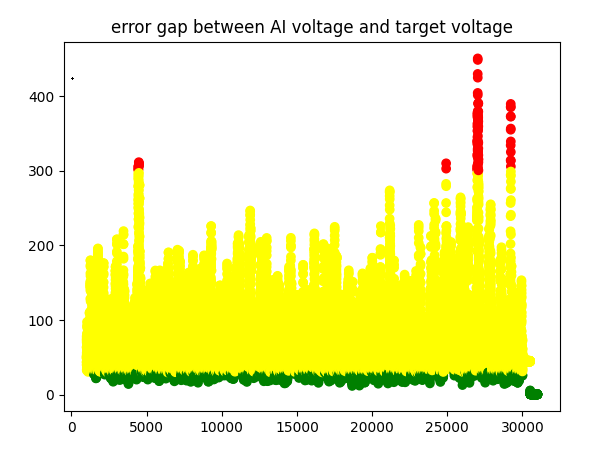
Though graphing the proportion at the green level. It is going up. The AI is having more moments when it has issues, but the proportion of time it spends being highly matched is increasing.
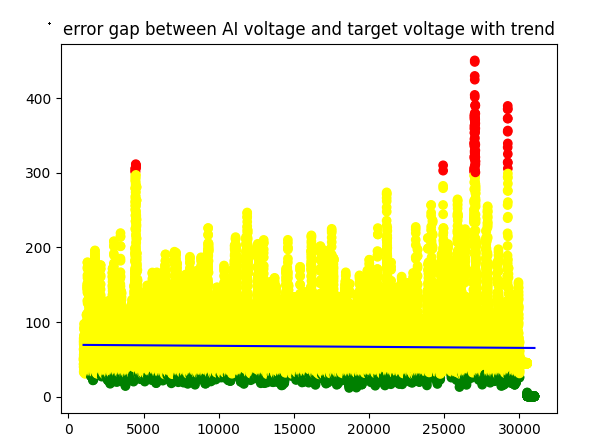
Though graphing the proportion at the green level. It is going up. The AI is having more moments when it has issues, but the proportion of time it spends being highly matching is increasing.
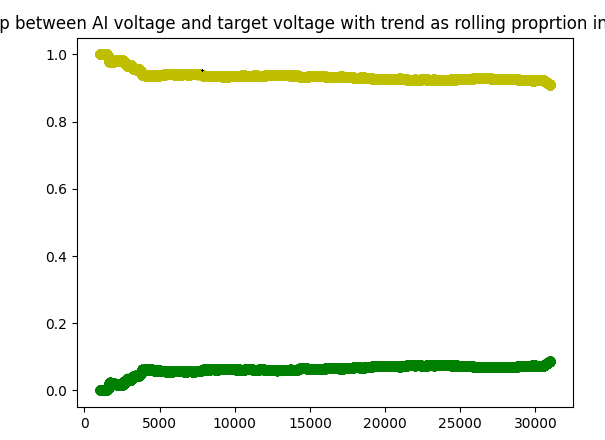
The time it should have represented is about an hour, I think. It has no inputs, so it should never match, but if the number goes down, it probably means the design is closer to human chemicals and how it works in human neurons. Also, as time goes on, chemicals should build up in simulated cells, especially where unbalanced or wrong, and the imbalance should cause the red events to happen more often. Therefore, if you keep doing this, get more accurate, then extend the simulation for longer (where the mismatch should become more pronounced again), you can get ever more accurate estimates of the underlying chemical processes going on.
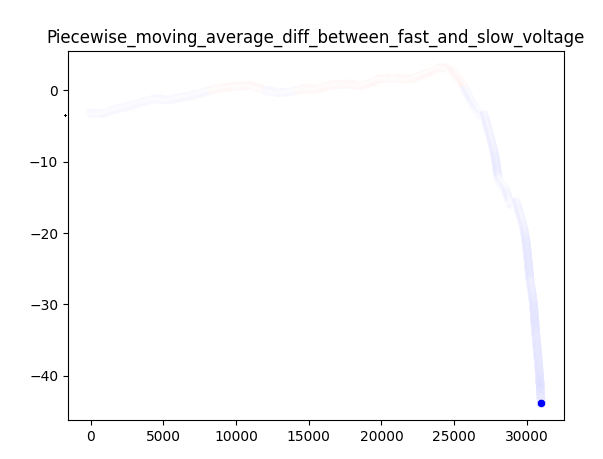
I also think if the AI was just overhitting, then de-syncing it would be a tight lowering on a moving average.
I looked at the moving average.s It has points where it improves and has moments of getting worse,se and I think that meansit'ss unlikely to be overfitting rapidly by using great changes and then breaking away.
Now, if you did that on a 121 scale of the human brain, it should be the same (but obviously I do not have a computer large enough). Therefore, what you aim to do is make something that manages to represent the core brain behaviours and abstract the rest, but surely that AI that can do that becomes a better candidate for use in other areas.
i.e. my philosophy is to data mine the GOAT of our brain for design principles to develop other AI.
Therefore, I am not especially sure how accurate it is,s but it all points to being a very close emulation of what goes on in our skulls while showing that, practically, if you wanted to upload your thoughts, that green area on the graph would need to be much higher; doing more experiments and doing extended testing.
But I think you could create an exponent of yourself. It does (whatever YOU are) look to be something like data if the green line goes up. Simultanously it admitedly does not go up quickly and
All I have to say is if the green line goes up,p does that mean the AI is more like the human? If I had 10-100 hours of human brain waves, would it work? I would think I would be lucky if that happened,ppened but you can see it looks to be going the right way. Ithink thea next step would be some really long time periods for simulation.
I think with this and OMEN, you could design a test for practical brain uploading. I know that sounds fantastic, al but why not? I can make AI like a brain, and I have an experiment that makes AI like an LLM. Well, surely combining them is AI after trained waves, brain waves, and chat logs on a task answers it; it answered questions known to the human but not included in the chat it was trained on; then it would be evidential that information passed into the AI during its training.
Add comment
Comments