Jean Baudrillard: "Simulation threatens the difference between the 'true' and the 'false,' the 'real' and the 'imaginary.'"
This blog post is again about splitting my current work into two development streams; one is to continue refining the chemical model that builds the simulation behind the brain emulation. The other setups a chatbot that uses that simulation to start to cement dual use cases
I wanted to take my biologically plausible network and make it into an LLM or SLM because that is the point of this Hello World series: to build something that is basically a brain emulation and get it to talk (hence “Hello world” as a programmer's first line of code for the signifier of building the first conscious AI (I am more humble than that sounds I swear).
There are a few reasons to do this. One is to get a precise regression analysis of the optimisation for medical uses. I reckon I probably need a 5k sample size, and that’s going to take some time to generate.
Brain Emulation Hits The Wall
Edit: truth be told, while writing this got this setup to send out, remembered a batch had just finished and checked the stats to find a new improvement, so it keeps getting better. So, in keeping with evolutionary theory, as a system progresses, es new developments get rarer, i.e., it's why evolution does not keep adding to us because it takes more time exponentially to make the GOAT more perfect. So it is only my patience that hit a wall. Evolution is a long road....
The AI has not continued to get better, and development has slowed compared to human brain waves .AI human but I think now I have got all the low-hanging fruit, and I would not expect it to get ever and ever better. The point was to use the genetic algorithm to traverse-engineer a rough method for training a biologically plausible AI, and I used a lot of statistical “tricks” here and there.
But it works its stable. It did what I expected it to. Continuous improvement will be tried, but the core doesn't need to get ever and ever better to start on other use cases from the medical use case.
I did explore sending off lots of emails to see about business investment. I think continuing to add to the offering is possibly the only way to tempt someone to invest in me to actually go operational.
Brain Wave Charts
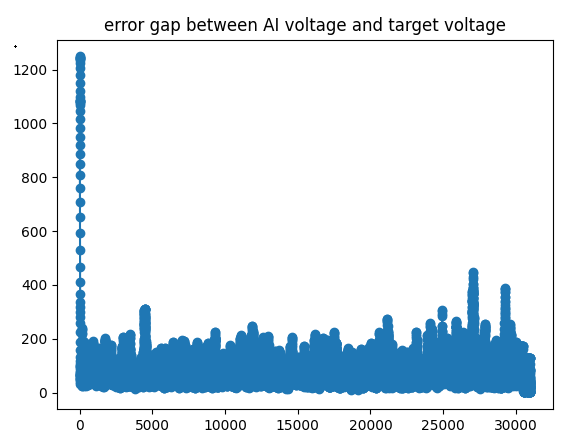
I made charts for the error between my brain wave emulation and the human brain in millivolts. I am playing with different visualisations for its actual performance and am likely to have some hard data in the next post.
Evolving the Evolutionary Algorithm
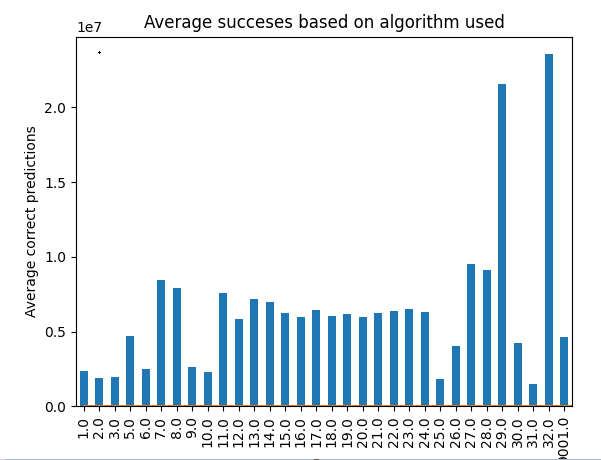
Have been charting which generation algorithm works for getting the best results and have come up with a set of principles that I would use if I did this again.
29 and 32 are late editions, as is anything after 24. 1,2,3,2, 3, aree controls to do stupid counterfactual things on purpose. 9/10 were surprise duds.
I am uncertain if the new AI will repeat, and it will be interesting to get counterfactual data. But broadly, I think I would try using a few different tests next time,e as I do not know if the reason it worked is that it combines lots of different methods for generating new results and combines the best populations or if I could just use a smaller group of better algorithms.
I am not going to go through the full list, but I have a lot: I have genetic algorithms in the list, gravity-based descent (did not work as well as I hoped), regression-based systems, an AI-assisted process, all sorts. I think if I went through it, then it would be a blog post in itself.
Therefore, when I have data from both Elihu and the new OMEN chatbot, I should be able to draw some conclusions from that and identify some reasons on what works and not because it's a non-standard way to design differential equations, say, compared to Euler's method, (i am pretty sure its that for trainning differential equations) it would be a good idea to look into that.
Deja Vu
I have built a chatbot out of biologically plausible neurons before and failed and failed badly. Now, admittedly, when I look back at those experiments, I can see why they would not work.
So I am back to building a chat bot but now from the basis of having built a genuine biologically plausible base as the starting point and I am going to carry on with that in the background and I am going to try and follow the logic that a change has to work on simulating a human brain and show improvement until follow up tests into the chat bot application I did not start with words on the detection from the get go so calibrating the algorithm against our own brain seems to have helped as well as more general the data capture from the databases and heavy automated testing from the evolutionary algorithm.
If his works it will demonstrate the rough idea of reusing the evolutionary algorithms infrastructure to customise AI to tasks.
Originally, I started with this as the premise: build a biologically plausible network and build a chatbot out of it. That is why this is called Hello World and not Ghost in the Shell or Matrix or something about brain uploads. Though there really was not anything to anchor into to know how to optimise it, and this was before I built the evolutionary algorithm and the database systems I now use to track changes, and this largely made the process impossible to track what changes did what. I am finding that the issue with this type of AI is that it takes a lot of testing to validate a single aspect.
Though last time I did this, I did not start with words on the screen.
Post Human Dreams
Come on, a biomorphic, biologically plausible neural network that did all the above (fingers crossed) is really interesting as a proposition, as different from the current-gen AI transformer. I think I can get away with using more cyberpunk phrases.
So I have a biologically plausible neural network design from running the brain emulation experiment and harvesting data. I spent some time rebuilding my experiments, and I retooled the evolutionary algorithms setup to start new tests with this chatbot.
This chatbot will be used as a test case for the best procedures for extracting information and inputting information into the model.
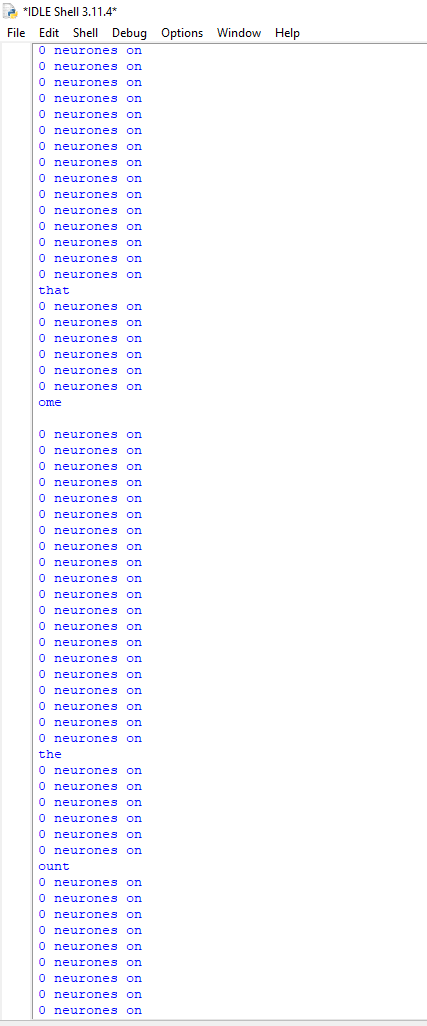
The thing about a brain emulation is that it just produces waves, but that is not machine-readable. Therefore, I have set up a series of tests and automated them via the evolutionary algorithm. This will tell me what method of input works best to take outside events and best add information into the brain emulation and output, where the output is data and not a wave of its own.
It sort of makes sense that the human brain is all wibbly wobbly wavey brain waves. Unfortunately, C does not come with a wave data structure. Machines deal in 0s and 1s, which form into bytes, become floats, ints and therefore tend towards traditional maths. Well, how do you do traditional maths with waves? Well, I do not know,w so I am having to find out. As you can see from above, the challenge has not been insurmountable.
But if you get that done,e then you have a simulation that can act as a bridge between those two domains.
In theory, this should be better than the transformer, both because of the well, of course, because it's more closely based on us (I think we are smarter than AI). But also, hopefully, a lot of the energy-saving capabilities of the brain carry over. So in theory it should be performative, and if not, well, go , go evolutionary algorithm daddy wants to disrupt the primary AI paradigm, and you just need to keep writing better versions of yourself; I believe in you (crosses fingers, - because it's worked this far).
Conclusion and Naming Conventions
Well, I cannot call it Trevor, could I...
So I spent a day looking at what to call it. I like Acronyms where it. The base is trying to be as close as possible to human brain dynamics. I like the name Palantir, but it's taken. The original project is called Elihu.
For some reason, I get oddly fixated on naming these different projects as I build them.
I went for OMEN for Organic Mind Emulation Network.
I am also wondering if the Organic should be Organicae or Organicu as in Organicae Mind Emulation Network; because the root Latin etymology for Organic has a dual meaning of instrument and biological and therefore making it more “neo latin” like might signal that play on words between organic as in the project goal of biological brain emulation or instrument as in instrumental mind emulative network as in the instrumentalise of that goal; both meanings seem appropriate and I like the.
I probably should just stick with the initial one as the latter screams something from Anime. But I strongly considered it. Organoid Mind Emulation Network (Check if that's from the Guyver)?
It is exactly what it is. It sounds like something that my 13-year-old D&D self would make up. It actually has an acronym that exactly describes the actual thing and design philosophy.
I could drop the O, but then it would be just ME, N, and that seems a silly name. You could do EN for emulation network, but it does not say whatit'ss emulating. OEN just does not have that zing. Task-Based AI
I think there are three reasons to build this. One is that if I combine that with the project Elihu base for emulating the brain,n then surely we could copy out your brain waves and combine it with learning your speech and writing, and I do not know if that would be an exponent of you, ou but I'd like to try that experiment.
That would be your exponents or uploaded intelligent idea, and your experiments around that would be focused on identifying what information can be gleaned from the brain simulation. i.e. can I have you do an exercise with this EEG device on and afterwards ask the AI about your wife? Will it remember? Would it remember what you had for breakfast? I do not know. I would think the predominant thing your brain does is continuously keeping the heartbeat going, and so with all that irrelevant data, I err on the side that it would not extract stable information, but I have no idea.
I do not fetishise the idea of immortality; the idea of uploading into a computer feels like a downgrade from a body. I am here just for the science experiment,t but hey, maybe if you could get high-fidelity and detailed data extraction from enough brain waves, well, I kind of wondered what it would be like to be around when the sun goes out.
The other idea is that if you could get it highly performative is that well, transformers do not seem to be very good at being agents. I know they say they are, but surely to be an agent of someone properly implies cognitive understanding of the task and the person's intent, and the continuous loop of thinking and acting does not feel like the generation loop used by generative AI. I just feel that something closer to us will work better here. So would like to train an AI and then try that.
Then I think you could get something that sits on an endpoint and supplies a service. That does not just generate text but sits and does a task. If I combine that with the evolutionary algorithm, I could get data on a specific task,k customise the base AI to it and then deploy,
Hence, task-based AI is AI that is evolved for the task, and therefore hopefully you can extend that leash compared to an traditional agent to let the AI have more authority.
Have not really thought about that much…. Feel like I should properly research specific benchmarks, etc. It would be good to look at comparisons with transformer tech etc.
So I built a brain emulation in the project; Elihu is now looking at the practical application of using that base for other technology. If I get this bit running, then honest question, but can someone give me one of those expensive EEG headsets (borrowing would be fine too) we can try and set the record for first person into cyberspace (dunno if the exponent simulant is a person either legally, technically, or even semantically, etc). I will do it if you are lucky, it does not need surgery.... Just put this hat on and think pleasant thoughts....
Add comment
Comments