“The mind has no firewall” – Timothy L. Thomas.
In 1998, in the US Army War College Quarterly, the phrase; the mind has no firewall. In that context, it was intended to highlight that human beings have no equivalent to a firewall that stops the imparting of hostile memes, propaganda or bad ideas. I am intending to use it here to show you might be able to copy out the whole thing and assess that as a truth claim.
Background
I have been trying to build a biologically plausible AI, and this would be one where very little in it was abstracted out, like the current GPT, and it is much closer to how our brain works in a 121 simulation. What I have been doing is trying to take EEG data and map that into an AI to demonstrate that truth claim.
I hypothesise that the missing piece is a proper chemical simulation of the cell, and if you do that and work backwards from a Hodgkin-Huxley simulation of a human spiking neuron, then you will get a neural fluid network where the brain is not just those neurons and connections, but also an environment that affects chemicals inside the cell, and this is also part of its learning.
Mathematically, ly this is quite complex, producing a lot of fluid calculations; intuitively, it's quite obvious that human cells are bags of chemicals that change the permeability of that bag to allow inflows and outflows of the chemicals that change the cell's behaviour.
What I then built is a model for this,s and working with an evolutionary algorithm to try and fit the right rules for these inflows and outflows so we can take a simulated “bag” of chemicals, pair it with an EEG sensor, take readings and try and change those chemicals until the simulation starts to resemble the EEG.
The model has no input from the EEG; it is a time-driven model. In theory, if perfect,t it would be a copy in practice that is likely impossible. The intent here is to prove the possibility of “uploading” a brain under the most stark conditions, where the only conclusion is to assess Timothy L. Thomas' quote as being fully demonstrated.
What is an EEG, and the hard and soft hypotheses?s
A EEG represents a dry or wet sensor on your cranium, and it measures the changes in voltage (usually measured in milli-volts). When neurons fire,e they spike and the voltage of the EEG spikes with it; when they recover, er they become negative voltage, and the EEG goes down. The behaviour is characterised by sudden spiking and long periods of a lowering of voltage, often called the refractory period.
It is worth noting that it is measured in millivolts because any spike in neuron activity is often attenuated such that it is divided by a factor of 10-100 by the time it reaches the sensor. This attenuation is affected by the distance of the nerve to the sensor. Therefore, it can be different based on how you put the sensor,r and largelan a EEG can be thought of as a rough estimate rather than a precise measure of brain waves.
Using invasive techniques, you can remove that scalp attenuation,n in which case the accuracy is much higher because of less noise. To be rough,gh it would be equivalent to within 1 millivolt, but the readings are now 10-100 times higher than the scalp level EEG. At the level of an invasive brain computer interface (BCI), you can accurately see and isolate the firing of individual neurons. At the scalp level EEG, you would need an accuracy of about 1, and you would be predicting individual neurons before firing.
I talked about the hard and soft hypothesis so largely for my AI simulation to be beneficial, it must really show that it can be below those numbers of 10 millivolts or 1 millivolts, if you are to think it's real,dy genuine information out of the head, which I am labelling the hard hypothesis to say brain emulation is possible. Above this, you would still get information from the simulation, but it would be an estimation tool. Below 10 millivolt,s we would say the AI is predicting the bra, in and below 1, well,l anyone fancy a trip to the matrix?
Current State
My current data points to it being possible in my long-haul testing. There are 30 sensors in the test (standard spacing tends to max out at around 36 from memory). It is a long-haul test, so it's done over 300,000 snapshots of the brain.
Currently, all have this degenerative curve downward.s I am working on the hypothesis that this is true in early testing (currently at gen 44, and they are curtailed at 4000 time steps for the evolutionary algorithm). Therefore, I think this is the chemical model that rapidly gets the AI in sync with the brain, but then overshoots and goes into a degenerative state.
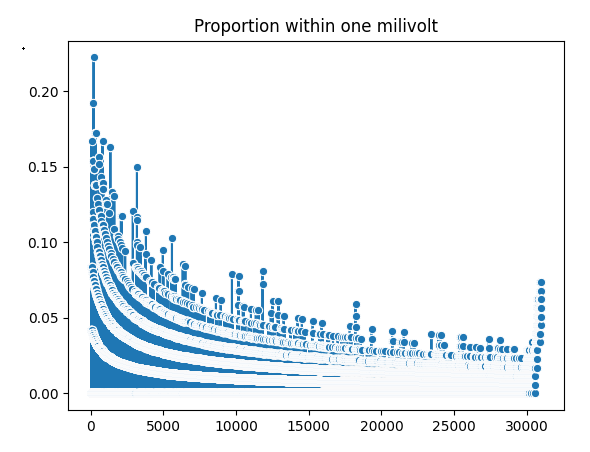
I think getting it to 20% within 1 millivolt and 70% within 10 is good for the amount of time I've been working with this evolutionary algorithm.
The bit trailing up at the end is where, at the end of the session, the person has a calm-down like session, and the bit in between is when they are being challenged. Therefore, the points the AI is struggling with are also the points the human brain is firing at full capacity. Therefore, it is sort of reasonable for it to have this bending, but it is showing that the AI is struggling to keep up.
That means it might work really well for my sleep wearable idea I already have, but I would need to contact sleep clinics to look into that, and a theory to test out is that it only syncs when the brain is calm and then its rapid, fast-acting thoughts knock it out of sync. The fact that it goes back up at the end is gratifying.
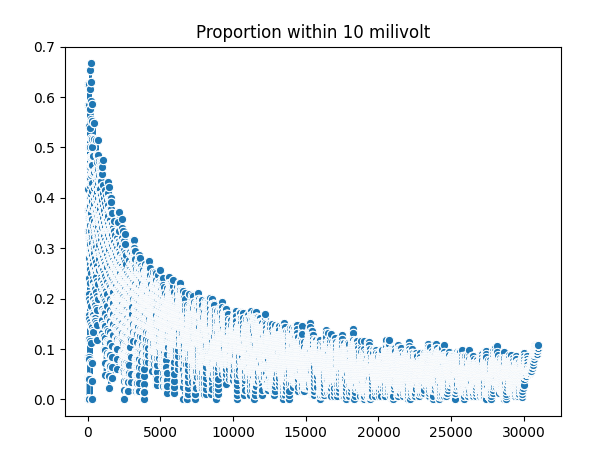
The good news is I still think the model is improving inside my evolutionary algorithm, and I have a lot of data left to keep testing.
The Brain does have a firewall after all
Well, I am not a hundred percent sure, but the brain has a long refractory period. I initially assumed that, with small imperfections in the chemical model, chemicals would build up and internal reactions would damp them down.
Early tests and graphing voltage supported this.
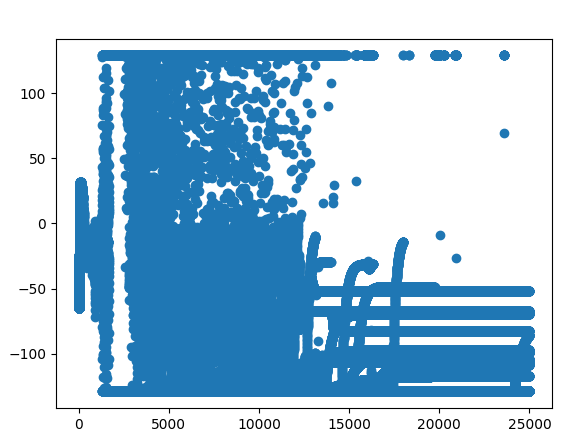
Though sometimes this was overcome, which is why I am bullish that the evolutionary algorithm is going to optimise itself out of this, but I am starting to plan on tests to ensure this happens.
Below demonstration of one where the firing does not stall and does refire, which I have had recently from the evolutionary algorithm, therefore I think it will push through. Though exploring graphing and analysis of the chemical makeup of the simulation itself to see if I can diagnose the issues.
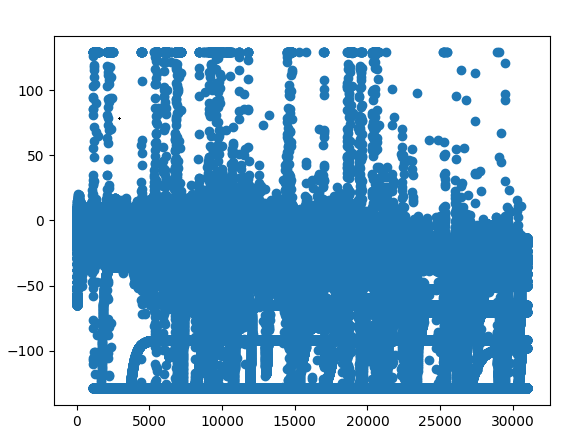
The fact that it does cycle well enough is probably enough for me to conclude its under developed for the full use case, but it definitely points at that there is a chance cold get out of it the full working model if I leave it. I got back the initial graphs for the evolutionary model, and it's clear that different chemical mixes do perform differently, but it's not a simple calculation, and the data is way too sparse currently to know exactly why a given version did well or not.
The Hard Hypothesis Is Not Impossible, Only Hard
I mean, it does sometimes get into that within 1 millivolt, meaning it predicts individual neurons before they fire. If only it stayed in that state.
Therefore, I am currently trying to work around this degenerative problem. But I think they're wrong, the mind does have a firewall, it's that it has lots of chemical flow, and they all need to be timed right to make the process work. I currently think this can be overcome with more controlled training, and have built a fork of the main database to trial slowed and or different models.
My concern is that a lot of the plots either look chaotic or have weird frequency patterns like above is an example that shows “patterns”; where you see distinct phases in the firing patterns; and I am starting to think of contingencies of more dynamic systems or tests to do to resolve that stage and it remains an early stage of the project and it might just evolve past it using the currently designed evolutionary algorithm. But I think we have found the mind's firewall; every chemical needs to line up, and guessing that is hard. But it does hit 70% there in a short period on the under 10 milivolts, so I am hoping it's just overshooting, and I have some test cases to curtail that. I have high hopes for what I can do in a few years.
The other theory that I need to follow up on is that I have just assumed that I can overclock a lot of these neuron simulations to cut down on the amount I need to simulate. Going upwards in computing power could be another choice, as a metaphor is presently the chemical is like the neuron getting tired, and its rest period is not being respected. Well, if I split the load across more simulated neurones, then that could work. I have not got a lot of Compute and doing so would slow down the evolutionary algorithm, so strangely it probably is that simple, but oddly it makes sense to try the hard stuff first and work out where the evolutionary algorithm quits.
I plan to drip-feed reviews of the code and trial different versions. Then look at whether anyone wants this code I wrote.
I have a written business plan, which at the moment feels a bit unreal for me to start writing to people. I am also in this weird position because, ideally, to do the sleep monitoring design, the excessive hard hypothesis behaviour is unwanted (who wants that thought of uploading a EEG for dream and sleep analysis to know it's going into a machine and not knowing if it's trying to become you...ewww). Therefore, I really need to resolve this as a plan, as ideally, I want to have a product out of this. Currently, short-term stability and then falling apart is less helpful than long-term mediocre performance.
Ideally, it would be easier if it were about just 70% on the within 10 milivolts and 0% on within 1 milivolts. I mean, I have no personal issues with using that product, but if I had a marketing department, I would think they would be scratching their heads (and if they were using the product, then logically being within 1 milivolt 20% of the time, there is a 20% chance the AI would also experience the head scratching; which I think I am joking but sort of unsure how that works).
I think with this regard, I did speak to someone with medical training and got the advice to seek out some neuroscientists and go from there. A small pivot would be to work out if I could get any support from Universities. There are some nearby, and I could enquire and or look at accelerators again, of which I was disappointed last time, but hopefully with some more data... maybe... My issue is that, ideally, you would use a common scalp BCI to simulate your brain, get as close as possible and then read the chemical data if it's roughly there, and if it's really accurate, I would look at BCI for cybernetics, etc. I feel my problem is I cannot make a Fitbit and Robocop at the same time, and then say hey do not worry about your sleep wearable copying your brain wave.
I mean, imagine a wearable, and at the end, they say in terms and conditions, "and you allow data processing for a homonculus of your brain," and then it's a sleep or gym wearable.
Ideally, it should only be applicable in one of those use cases, and currently, I am sort of stuck between both without doing either very well. I probably am going to see if there is funding or something for it in the coming weeks. I lean on the side; it might be just the soft hypothesis that is possible that the stateful nature of the brain and the obfuscated chemical content inside a cell problematize the idea of "copying" data from it. That is me thinking in terms of common sense, a philosophy that the self is unviable, indivisible, and non-writable.
Though as a data analyst, the line on performance over time goes up, this is currently better than when I started... So, the question do I want to be that guy that just rabidly repeats the line, go up and just go with it... I mean, I am not a philosopher, I am an analyst, and the line goes up...
There is also the issue I have now, a list of both current features being assessed as improvements and a laundry list of more to add, with the problem that yes, some of them work. It does look possible moving forward to just analyse and shorten the gap, then rinse and repeat.
I mean, it does look like the hard hypothesis of yes, you could copy-paste a brain wave into a machine, and that does technically not look utterly impossible, only really hard…. I genuinely, after a few years' effort, got a whole minimum viable brain simulation for all of a handful of steps there.... Cheers for that, I made peace with building an over-engineered fitness or sleep wearable. But in one sense, the brain has no firewall. It does look like you can copy stuff out in another sense, good luck keeping it cogent and in time seems to be the technical challenge, which to me looks like a really clever encryption process, kind of like a firewall.
Add comment
Comments
Interesting! I shall watch either interest 😊